
Ainsley
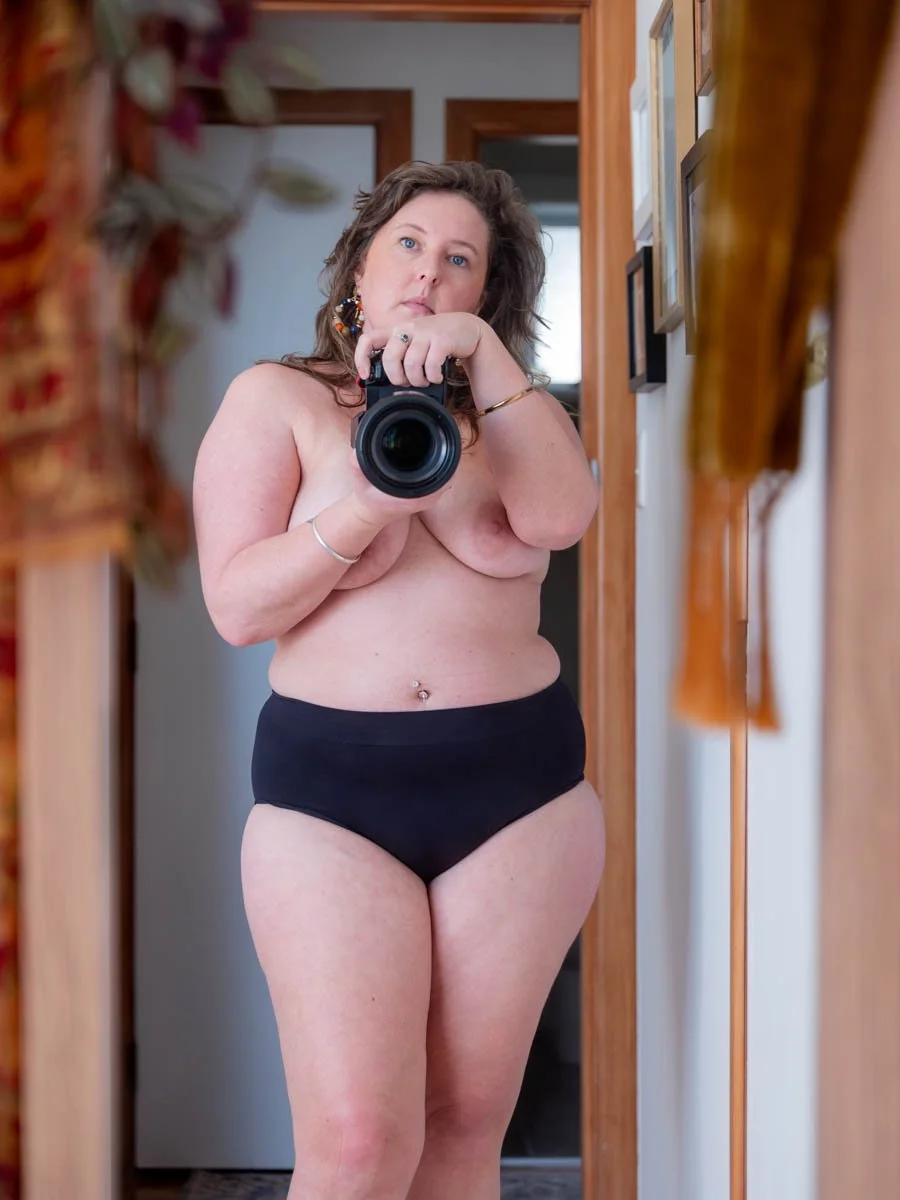
Ainsley, 35, Auckland
Listen to Ainsley’s Story
Read Ainsley’s Story
Like most of the other people in this exhibition, my journey with endometriosis and adenomyosis was long, complicated, and a little bit traumatic.
I had always had painful periods as a teenager. I remember quite vividly being in my school uniform in high school and feeling so uncomfortable and hot and achy, and wondering how it was possible that all the other girls were totally fine when they got theirs. It didn't make sense to me.
But because my mum also had painful periods, we just thought that we were unlucky. And, unfortunately, my mum didn't get diagnosed until she was in her fifties, so we had no idea that we were both carrying this disease.
I had IBS symptoms all throughout my teenage years. It got worse when I got into university. Went to the doctor repeatedly and was just told that it was stress.
Unfortunately, those symptoms got worse and worse, and my periods got worse and worse, to the point that I would be in completely debilitating pain on the floor, wondering if I should call an ambulance because I thought that I might be dying. It was just out-of-body, mind-numbing pain.
That's when I realized that something was really wrong. First found out about endometriosis through social media, and as soon as I saw what the symptoms were, it instantly clicked for me that this must be what it was.
I tried to go to several gynecologists. Was just told that I was just unlucky and that it likely wasn't endometriosis because my periods weren't heavy enough, even though that is not a requirement for endometriosis at all.
I was offered an IUD to try and help with the period pain and had a really traumatic and awful experience getting that in. It went horribly wrong, the procedure, and a week later I ended up back in the hospital in the emergency department as it tried to expel itself from my uterus.
From that experience, I ended up getting quite severe PTSD, which made the next few years of gynecology appointments incredibly difficult.
Endometriosis symptoms became so severe that it was everyday pain now, just completely ramped up the pain, unfortunately. Going back, being admitted into hospital for extreme pelvic pain, having to go through these incredibly traumatic, invasive procedures and checks and scans, just to be told again and again and again that everything was clear.
They couldn't see any reason why I was in this pain.
“Just because endometriosis is trendy doesn't mean it's what it is.”
“It could just be learned pelvic pain.”
Every excuse under the sun.
Even though I knew in my mind that it was endometriosis, I happened to be discharged by an endometriosis specialist, pure luck, that she took one look at my notes and said, “Oh, yes. I would say this is endometriosis. I will refer you to a specialist.”
It was the first time that someone had listened to me and had validated my experience. She ended up being my surgeon.
I had deep infiltrating endometriosis all over me.
About three months where I was feeling pretty good after that. Less pain, less fatigue, able to actually function and do some work.
Unfortunately, then I got COVID, and that just sent my body into a massive inflammatory response. I went back to having pain all the time.
My periods were never better after the surgery, which makes me believe that I also have adenomyosis. And I kept getting sick month after month. I got a wisdom tooth infection and it was at that point that I had a full mental and physical breakdown.
I was in bed for days, unable to sleep, eat, walk, talk, anything, just catatonic. My mind had just left my body because I was in so much pain, and I could not deal with it anymore, and became suicidal.
I just, I didn't wanna be in this body anymore.
So that was kind of the turning point for me.
Since then, it's just been a really slow journey trying to get back on track. I'm at a point in my life now where I'm actually able to function, and I'm so grateful for that because all I ever wanted to do was get to a point where I could help others so that others didn't have to go through what I had gone through.
I was thinking that something good has to come out of this. I have to use this, this awful, awful experience to help other people.
And that was how Now You See Me came about.
And I just wanted to make people feel less alone. I wanted to share people's stories because I think the stories that are shared in this exhibition are so powerful.
And if we could get politicians and medical professionals and specialists to listen to these stories, would our level of care improve? Would that level of gaslighting go down? Would we be believed? Would we be heard?
That is my ultimate aim in this: to raise awareness, foster a sense of community, and just let people know that we're here and we're not going anywhere, and it's about time that you actually start listening to us.